If you’re organizing a festival, fair, or vendor event and thinking about how to capture it for next year’s marketing, there’s a trap almost everyone falls into: assuming the goal is just to prove the place was packed. A big crowd shot has its place — it’s real social proof, and it tells people your event is worth showing up for. But a wide shot of a full venue only gets you so far. What actually makes people want to come back, or convinces someone on the fence to buy a ticket, is the sense that something specific and memorable happens there.
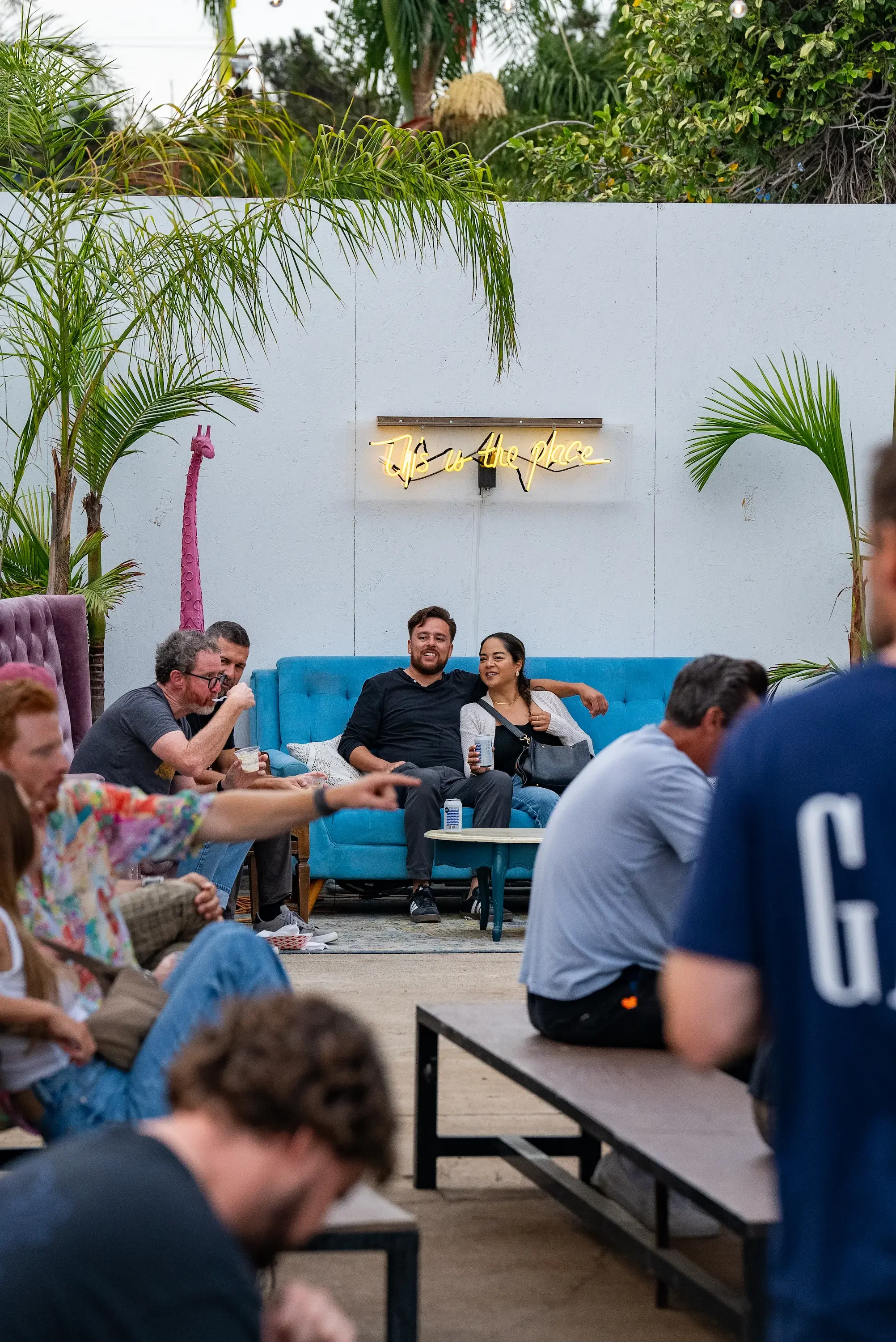
CROWDS PROVE POPULARITY. STORYLINES SELL EXPERIENCE.
People don’t respond to “there were a lot of people here.” They respond to “here’s the kind of moment I could have if I show up.” That means the content that actually drives return attendance and new ticket sales isn’t the drone shot over the main stage — it’s the crowd surfer getting passed overhead, the stranger-turned-dance-partner on the walkway between stages, the bartender who’s clearly having as much fun as the guests. Those are the details that make someone picture themselves there next year.
I ran into this same principle shooting a small art studio’s gallery opening in North County. The space wasn’t dramatically lit, and it wasn’t packed shoulder-to-shoulder — but that didn’t matter, because the real content wasn’t the room, it was the moments happening inside it: someone caught mid-thought staring at a painting, a handshake between a guest and the artist, someone reaching for the charcuterie board or swirling a glass of wine mid-conversation. Those small, human interactions told the story of what the event actually felt like far better than a wide shot of the gallery ever could — and gave the studio real material to use in promoting whatever they run next.
WHAT THIS LOOKS LIKE FOR A VENDOR BOOTH
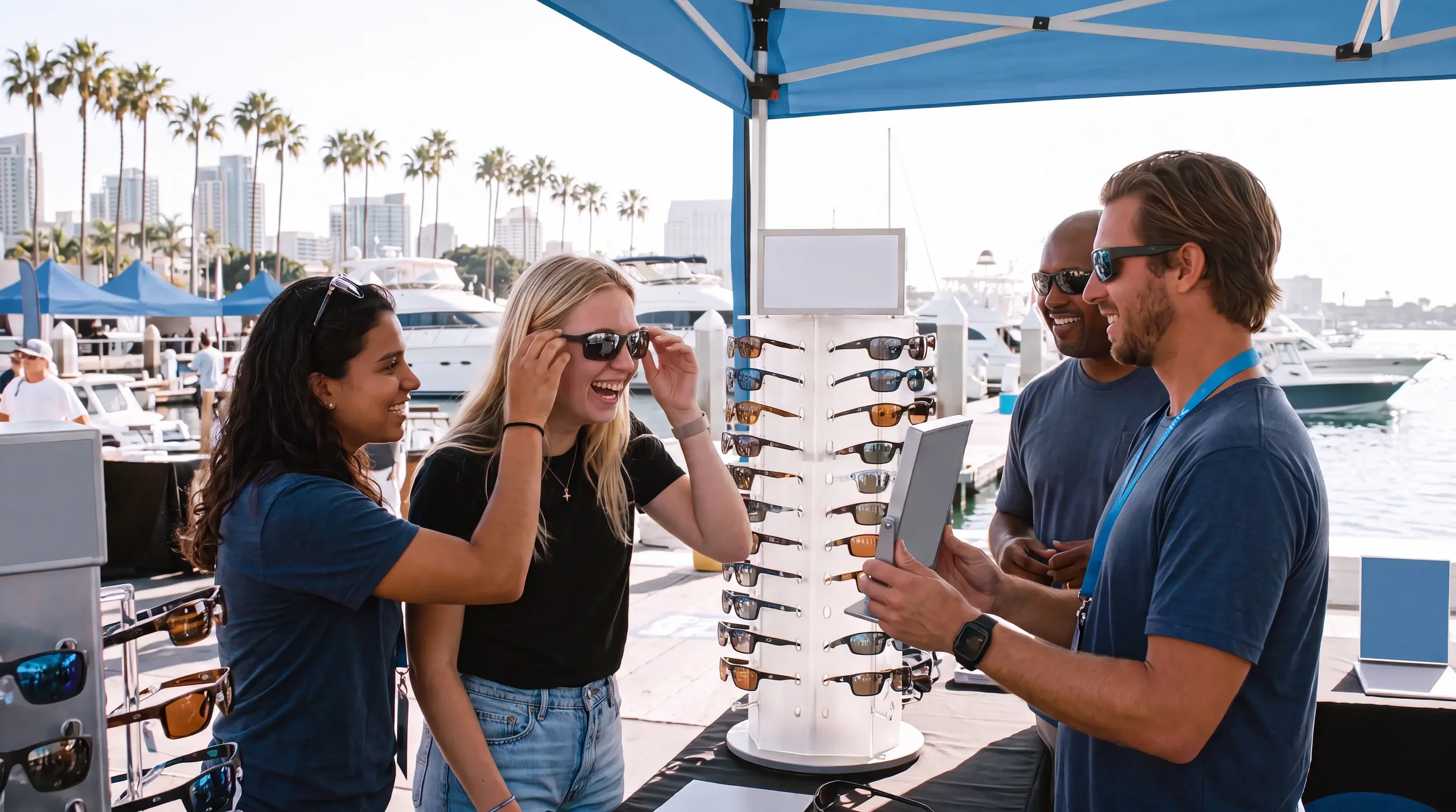
The same logic scales down to an individual booth inside a bigger event. I shot a booth for Costa at a boat fair, set up to sell sunglasses to boat owners on-site. The instinct for most booths is to photograph the product — sunglasses on a table, a logo banner, maybe a rep handing something to a customer. But the better booths aren’t really selling a product in that moment, they’re creating an experience: try this on, talk to our rep, see how this actually fits your life, take advantage of this deal while you’re here.
If you apply the same storyline thinking to a booth as you would to an entire event, the goal shifts: capture the interaction, not just the inventory. A customer laughing while trying on a pair of sunglasses with a rep. Someone genuinely engaged in conversation at the booth, not posed and looking at the camera. The goal is content that carries some of the actual energy of the brand experience — because that’s what makes someone scrolling past a social post feel like they’re missing out on something, rather than just seeing another product photo.
WHAT THIS MEANS FOR ORGANIZERS PLANNING COVERAGE
If you’re the one hiring a photographer for your event, here’s what to actually ask for:
A mix, not just wide shots. Yes, get a few genuine crowd and full-venue shots — you need those for straightforward proof of turnout and scale. But don’t let that be the whole shoot list.
Direct the photographer toward interactions, not just scenery. The best storyline moments usually involve two or more people connecting — a laugh, a shared reaction, a genuine exchange — not a single person posed in front of a backdrop.
Cover the in-between moments, not just the headline moments. The main stage performance matters, but so does the walk between stages, the line at the food truck, the quiet corner where people are actually hanging out. Those secondary moments are often what makes an event feel alive rather than just busy.
Think ahead to next year’s marketing, not just this year’s recap. The photos that convince someone to buy a ticket next year are the ones that make them imagine themselves in that exact moment — which means storyline-driven images tend to have a much longer shelf life in your marketing than a single hero crowd shot.
The photographers who default to “get the biggest, fullest-looking shot possible” aren’t wrong, exactly — that content has a role. But it’s rarely the content that actually moves people to act. The events (and booths) that get people to come back are the ones that capture what it actually felt like to be there, told through the small, specific moments that a wide shot can never show.
Planning coverage for an upcoming event or booth and want photography that’s built around what actually gets people to show up next time? Reach out and let’s talk through what storylines are worth capturing at your event.s